Find me online!

twittergoogle plusemail
Showing posts with label History. Show all posts

September 4, 2013

Book Review - How Rome Fell by Adrian Goldsworthy

Over the last few years, I've really developed a healthy interest in the history of the western Roman Empire and that era. I loved the "History of Rome" podcast (and am currently enjoying the "History of Byzantium" podcast that was started when the original ended). There's just something about that era that is inherently interesting.

Yet I had never really read a completely comprehensive history of the empire.

That is, until 2009 when I picked up How Rome Fell by Adrian Goldsworthy. It's not a definitive history of the empire, but it is quite the extensive history from around the time of Marcus Aurelius died in 180 AD until it finally fell in 476 AD (though the date of the ending is still debated, and depends on what you consider the Roman Empire to begin with, I think).

The book is a very detailed history of all the ups and downs in the empire, the sixty years in the 3rd century where 65 men were claimed as emperor, the rise of the military as a king-maker (or emperor-maker, I guess) and all of that.

If you like your Roman history, or just ancient history in general, you can't go wrong with this thick tome. It's extensively researched and it's also very readable. It's not super-dry like some history books out there.

I still find myself picking this book up and thumbing through it when I'm trying to figure out something. For example, I saw this really odd movie, The Last Legion that supposedly begins with the last Roman emperor being spirited away from Rome from exile, taken to England and eventually (MAJOR SPOILER becoming King Arthur MAJOR SPOILER DONE).

While I knew it was a fantasy, the beginning of the movie did seem based in fact. The name of the emperor was correct, for example. So I picked up Goldsworthy's book and re-read the last part to see what actually happened. Needless to say, liberties had been taken, though it was closer than some movies are.

Goldsworthy has a wonderful writing style that I really enjoyed.

The review's on Curled Up With a Good Book.

Here's a snippet for you:
"Goldsworthy begins with the most important question: just how did Rome fall? Was it barbarian invasions? Societal decay and corruption? Opinions are divided on this issue, but Goldsworthy seems to see it as a combination of these things. Ostensibly, the Empire fell in 476 A.D., when the last Roman emperor who ruled from Italy was deposed by a Germanic invader. However, some see the Empire as having already fallen even before this date, with pretenders to the throne ruling before this. The Roman emperors since Marcus Aurelius died in 180 were much weaker for the most part than those who had preceded him. Throughout a period of 60 years or so in the third century, there were 65 claimants to the Roman throne, some lasting only days. Some say this internal strife is essentially what eventually killed the Empire, with the barbarians just being the executioners, and Goldsworthy seems to agree with that viewpoint."
I encourage you to check it out. It really is a great book!

Goldsworthy is also author of the excellent Antony & Cleopatra history.

July 31, 2013

Book Review - Last Man Standing by Dick Camp

Many are the horrors that soldiers went through during World War II. Most of the time, this can be mitigated by the fact that they were fighting the evil forces of Nazism or Totalitarianism.

But what if lives were wasted on a meaningless battle that really didn't have any effect on the outcome of the war?

One such instance would be the US invasion of Peleliu island in the Pacific Ocean. This battle was a meat-grinder for all involved, but especially for the 1st Marine Regiment which suffered catastrophic losses. Ultimately, while the battle would be won, the tactics involved have long been questioned. The necessity for the invasion has been as well.

Dick Camp (author of the wonderful book about the Najaf battle in 2004 in Iraq called City of the Dead) has written the story of the 1st Regiment's demise in Last Man Standing, a riveting account of the battle from these soldiers' perspectives. It's not a history of the battle itself, as Camp ends the book once the regiment has been withdrawn. But it is a testament to the courage of these Marines in a hopeless situation.

The book is extremely well-written, but be warned. Some of the pictures are a little graphic. Not bloody-graphic, but there are pictures of burned-out bodies of Japanese soldiers or dead Marines who had not been collected yet.

The rest of my review of the book is on Curled Up With a Good Book, and I encourage you to check it out for more information.

And if you like reading history books on World War II as much as I do, it's a must-read as well.

January 16, 2013

Book Review - The Brenner Assignment by Patrick K. O'Donnell

As stated in last week's book review post of O'Donnell's Dog Company, small war-time stories can be quite riveting, as we see what a few people are going through in their individual missions, the camaraderie that they have with their fellow soldiers (or whoever they're working with) and the potentially harsh circumstances that they're going through. Since many of these stories are done through interviews with the living, we get to see what those who didn't make it through the events of the book were like through the eyes of friends and colleagues.

It can be quite powerful.

Back in 2009, I read O'Donnell's The Brenner Assignment and was captivated. It's a true spy story that can have more impact than any fictionalized one. The Brenner Pass is a mountain pass through the Alps connecting Austria and Italy that the Germans were using to bring troops and supplies to their northern Italy war effort. The Allies wanted it closed to prevent this. This book is the story of the two missions that attempted to do this.

It has all the makings of a spy novel, but it has the benefit of actually having happened.

My review of the book is on Curled Up With a Good Book.

January 9, 2013

Book Review - Dog Company by Patrick K. O'Donnell

Being a military history guy, I love books that give the history of World War II (or any other war, really) in broad strokes, giving the whys and the hows, what the strategies were, that sort of thing.

But I also love looking at smaller parts of the war. What were individual soldiers thinking? What was happening in that one small village that the squad was supposed to patrol?

Patrick K. O'Donnell seems to specialize in the small, with books that talk about individual units and that come out of conversations and interviews with those who were involved. I had previously read and reviewed The Brenner Assignment (one that didn't make it on this site, so I will rectify that next week), so it was a natural that I would snap up O'Donnell's latest, Dog Company.

This is the story of the Army Rangers who stormed the cliffs of Pointe du Hoc during the Normandy landings. That's right.: they scaled sheer cliffs under withering fire to knock out a set of guns that were overlooking the beaches that could rain shells down on those heading for the beaches.

It's not just a story of Normandy, though. It's the story of courage, heroism, even desperation as they are later tasked with taking and defending a lonely hill in a German forest, one of the most needless (and thus even more costly, as the lives were given away for nothing) battles of World War II.

My review of it has gone live on Curled Up With a Good Book.

December 26, 2012

Book Review - The Battle of Britain by James Holland

Many thought Great Britain would fall to the Nazi onslaught during that fateful Summer of 1940. The country stood alone against the German juggernaut. France had just fallen; the Soviet Union was still ostensibly allied with Hitler's regime; the United States was still "neutral," though they did help the British out in a few capacities.

Adolf Hitler wanted to get Britain to sue for peace so he could concentrate on the Soviets. If that took an invasion, so be it. If Germany could pound Britain into submission via bombing, that would work too. Either way, the British Air Force must be destroyed.

I've read a few books on the months-long air battle known as "The Battle of Britain," but nothing as comprehensive as James Holland's book, also called The Battle of Britain: Five Months that Changed History. For one thing, it does what most other books on the battle don't do: it goes in-depth into the battle for France, and shows us just what that invasion did to both the British and Germans in preparation for the coming battle.

December 19, 2012

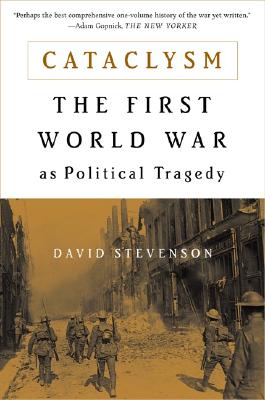
Book Review - Cataclysm: The First World War as Political Tragedy by David Stevenson

I've always been a military history guy, even dating back to third grade (that's the last memory I have of it, anyway). I used to read and collect these World War II cards (about 3 inches square, so not something like a trading card) that explained many aspects of World War II. I had read every World War II book at the Wilson Elementary School library by the time I finished 6th grade.

That has never changed. So when I had the chance to pick up Cataclysm, David Stevenson, I jumped at the chance (one of the great perks of reviewing for Curled Up With a Good Book). I had read a few things about World War I, but not anything comprehensive. This book looked seriously intriguing when I picked it off the "books to review" list back in 2005.

I wasn't disappointed. This book is very dense, which makes it extremely comprehensive for a 500-page book with a ton of end notes. If you have any interest in World War I, or just military history in general, this is the book for you.

From my review on Curled Up With a Good Book:
"It has been a while since I've really gushed about a book, but I won't be able to help myself with this one. Cataclysm: The First World War as Political Tragedy by David Stevenson has to be one of the best books I have ever read on World War I, and one of the most compact yet comprehensive history books I've seen. It is less than 500 pages, but it covers every aspect of the war, from the strategy involved to the politics of starting, running, and, most importantly, ending the war. It goes beyond even that, though, by discussing the impact the war had on the post-war years, analyzing the years between the two world wars and even how memories of the war affected how the second one was fought. As a final thought, the conclusion discusses how the war has been looked at over time, how perceptions have changed, not only of who started the war, but also how it was fought."
The only problem that I saw in the book was the really weird use (or lack thereof) of commas. It made it confusing at times, requiring me to reread a sentence or two to make sure I wasn't misunderstanding something.

I cannot recommend this book highly enough. If you'd like to see why, go check out the review.

May 30, 2012

Book Review - The Royal Stuarts by Allan Massie

Over the last few years, my love of History has transformed and broadened. I used to be mainly a military history nut, and I still am (and I'm still a nut, too, but that's unrelated). But I have also moved on to things like Medieval History, especially European History that encompasses almost anything from the end of the Roman Empire all the way up to more recent times.

One area I have not covered much is the history of Scotland. That's not really by choice; it's just that I haven't found a good book on the subject crossing my path. There should be one soon, I would think, as some little-studied (by me, anyway) areas of history keep popping up in books by authors I like.

The Royal Stuarts, by Allan Massie, sort of wets that whistle, though not entirely. The book is a biography of the entire Stuart line of kings and queens of England, from Robert II back in 1371 (Scotland only) all the way to James III (VIII in Scotland), a king without a country as he was in exile his entire life. Each chapter is about a monarch, so earlier chapters are shorter as there is less documentation on them than there is on later royal members.

My review of the book is up on Curled Up With a Good Book.

From my review:
"The history of Great Britain is well-mined territory for many casual history readers with any interest in Europe through the ages. Two areas that I have missed in all of my reading, however, are Scotland and the English kings (and queen) after Elizabeth. Many (like me) stop with Elizabeth and don't delve any further. However, the Stuarts are an interesting family in themselves, especially James I (best known for the King James version of the Bible) who immediately succeeded Elizabeth. With The Royal Stuarts, Allan Massie takes a look not only at James and his post-Elizabeth version of Great Britain, but also the entire Stuart family from beginning to end. A welcome side effect is that the reader gets a nice (if somewhat superficial) history of Scotland as well."
I greatly enjoyed this book, and I will have to make do on my promise to myself to find a book on Scottish history soon.

In the meantime, The Royal Stuarts will do me well. It's nice to see that the Stuarts were such a randy bunch of guys, especially the early ones.

April 21, 2012

Last Segments of Egyptian Book of the Dead Found

The archaeology of Ancient Egypt has always fascinated me, and I get a thrill when I hear about new discoveries about the ancient tombs, Pharaohs, or whatever. I know I have a few fellow travelers in that respect.

After yesterday's super-serious post, I thought I would present to you something that's more intriguing than anger-inducing.

Did you ever see The Mummy, with Brendan Fraser and Rachel Weisz?

One of the objects in the movie, and one that causes a bunch of problems for our heroes, is the Egyptian Book of the Dead. Evelyn (Weisz) reads a passage from the Book and it brings to life the ancient mummy Imhotep, a High Priest that was entombed for falling in love with the mistress of the Pharaoh.

We all know that these types of movies have tons of historical inaccuracies, but that's beside the point. They're a hell of a lot of fun. One inaccuracy is, of course, that they didn't have books back in Ancient Egypt. By "books," I mean bound copies with pages that you flip, even if they do appear to be metal plates or something like that in the movie.

No, they wrote everything on papyrus scrolls. Like this:

(Thanks to the Daily Mail)

The real Book of the Dead, or at least the most famous one, has been an incomplete set of papyrus scrolls and fragments that have been collected from museums over the last 100 years. But some pieces were still missing.

Until now.

April 20, 2012

World War II a "European Civil War?"

History is being increasingly whitewashed, either to avoid "offending" anybody (such as the suggestion that the Holocaust not be taught in schools for risk of offending modern Germans) or in some weird attempt to foster European unity.

The latter appears to be the case in the latest outrage.

The European Union is opening a £44 million museum called the House of European history that will change World War II to be "the European Civil War." (h/t: National Review's "The Corner")

What blatant stupidity! Not to mention offensiveness. It signifies an increasingly narrow viewpoint that disregards anything that's not European in nature, all in the name of trying to unify the continent?

It's patently absurd.

(Hint to the EU: This didn't take place in Europe. Thanks to Answers to the Questions)

December 28, 2011

Should the Holocaust be Taught in Schools?

That does seem like a stupid question, doesn't it?

(Thanks to the Telegraph)
Yet that's what one former Education Secretary is proposing for Britain. Lord Baker, who was Education Secretary under Thatcher and designed the National Curriculum, is advocating that History classes stop teaching children about the Holocaust. But it's not because he doesn't think that the kids can handle something that horrifying.

No, it's because it is supposedly giving kids a bad view of Germany. Yes, present-day Germany. Because, you know, kids are too stupid to separate modern Germany from the horrors of Hitler and Nazism.

This all appeared in an article in the Telegraph. I have checked for recent mentions of Lord Baker in the news, and this was the most recent article, so it doesn't appear that he's recanted or changed his mind or anything.

Actually, the idea about children is not totally off-base, though I don't believe that kids are "stupid." However, depending on how young they are, they are impressionable, and if the subject is not taught right, then it is possible to tar Germany in total with that brush. That shouldn't be a reason to stop teaching it, though. That should be a reason to improve the teaching of it, and History in general.

From what I understand, the teaching of History in school is not in a good state, and I think that needs to be improved.

December 27, 2011

Book Review - Pacific Air by David Sears

Those of you who know me know that I'm a huge World War II buff, having read numerous books on the subject. In fact, I remember having read every book on World War II in the Wilson Elementary School library by 3rd grade and wondering where I was going to find more to feed my hunger (Public library? What is this thing you speak of?).

That hasn't gone away as I've grown older. In fact, while my interests have branched out to a huge swath of history, I still love me a good World War II book, especially if it's about something I didn't know a lot about.

Thus comes David Sears' new book, Pacific Air. This book is all about the naval aviation aspect of the war in the Pacific Ocean against the Japanese. It talks about the pilots, the aircraft, the trials and tribulations as well as the triumphs of these flyboys. The other good thing about the book is that it's not totally American-centric. Sears does examine the life of a Japanese pilot as well, adding a fresh perspective to the whole thing.

It's a very good book, and one I'm glad I read. My review has now been posted on Curled Up With a Good Book.

From the review:
Students of World War II know that a large part of the war in the Pacific Ocean against the Japanese consisted of huge carrier battles, where enemy ships never saw each other and the war took place among the planes in the sky. These planes were based on aircraft carriers and the war was a back-and-forth battle between these planes to try and sink the enemy carriers before your own were sunk. Pacific Air by David Sears examines the war from the viewpoint of these pilots, and it's a great read.

Sears begins with the aircraft themselves, detailing how before the war, Grumman became one of the mainstays for the building of naval aircraft. He talks about the flight tests, the strengths and weaknesses of some of the first planes to fly off the assembly line. It is important to get a basic understanding regarding what these pilots were actually flying. However, while the first chapter starts with the reaction of the factory higher-ups when the attack on Pearl Harbor was announced (they were opening a new plant on the same day), and the second tells us about the first naval pilot casualties as they attempt to land in Hawaii and were shot at by panicked ground gunners, this does not make a riveting story for those readers just beginning the book.
Yes, the beginning of the book is really slow, but it definitely picks up and becomes an interesting read.

I give it a big thumbs up, though you pretty much do have to have an interest in World War II or it may not have the same effect that it had on me.

August 8, 2011

Book Review - Livia: Empress of Rome by Matthew Dennison

Livia, Empress of Rome: A BiographyI've had an interest in ancient Rome for a while now, but that was further stoked when the wife and I watched the BBC adaptation of Robert Graves' book, I, Claudius a few years back. The wife had seen it before, but I hadn't, and I was enthralled. I think Derek Jacobi, as Claudius, certainly helped. I loved the intrigue, almost soap opera-like.

In that show, Livia, wife of the Roman emperor Augustus, is portrayed as conniving and ruthless, doing anything she can to make sure that her son Tiberius rises to the throne when Augustus dies.

But is that real history?

Matthew Dennison says no, and he's written Livia: Empress of Rome in order to counteract that portrayal, which is taken from a number of Roman historians who seemed to have it in for her.

Sadly, Dennison's book only sometimes makes the case, and isn't interesting enough to hold the reader while he attempts to do so.

November 26, 2009

Book Review - Europe Between the Oceans

My review of Barry Cunliffe's Europe Between the Oceans has been posted to Curled Up With a Good Book.  This is one heavy tome!  But definitely worth reading if you're into the history of the Ancient World (well, western Ancient World, anyway).  It covers the years 9000 BC to 1000 AD, is full of fascinating maps and photography (the book's worth it for the photography alone), and really broadens your horizons about the origins of the various European peoples.

Just make sure, if you like to take books with you when you're out and about, that you're reading something else as well.  This is definitely a "read in one place" kind of book.

October 19, 2009

Auschwitz Launches Facebook Site

When I first saw this BBC article about the Polish authorities who are in charge of Auschwitz opening a Facebook site, my first thought was a bit of horror.  It seemed really odd and disrespectful to bring something like this to Facebook.

However, upon reading the article, I was mollified and I'm actually now a big fan of the decision.  To quote the article:
"A spokesman said the move was aimed at reaching the younger generation and educating them about the Holocaust.

It follows the launch by Auschwitz - now a state museum - of a YouTube channel earlier this year."
It's a fact that those survivors of the Holocaust are dying out.  Even if you were only four years old when you entered one of the camps, you are most likely in your 70s at the youngest.  Over the next 10-20 years, many of the survivors will have finally passed on.  It's very important that the current generation, and more importantly, the next generation remembers what happened so that it can never happen again.  There are already signs that people are forgetting, as many of the same things that led up to it are beginning to happen again.  Whatever the powers that be can do to bring the Holocaust to young people's attention is ok in my book.
"'If our mission is to educate the younger generation to be responsible in the contemporary world, what better tool can we use to reach them than the tools they use themselves?' said Mr Sawicki."
More power to them.  I'm going to go become a "fan" of the site right now.  You can find it here (of course, you have to be logged into Facebook to see it).

October 13, 2009

Marcus Aurelius - A Life (Review Posted)

Just wanted to post a brief note to say that Curled Up With a Good Book has posted my review of Frank McLynn's book, Marcus Aurelius: A Life.  This is an extremely interesting but horrendously tedious biography of the Roman emperor Marcus Aurelius.  Aurelius, famous for his book of thought called Meditations, was a stoic philosopher who tried very hard to rule with his stoic philosophies.  It didn't always work.

Anyway, short summary.  I'm very happy I read the book, but boy was it hard to get through. Marcus was a fascinating man, and McLynn definitely captures that.  Unfortunately, he captures it in a rather dull fashion.

Give the review a look and you'll see what I mean.

October 1, 2009

More Book Stuff - Heavy Books

As any of you who go down to the bottom of this page and look at my "GoodReads" widget (at least for now, though future visitors to this page won't see them), I'm currently reading two books:  Europe Between the Oceans: 9000 B.C. to 1000 A.D. by Barry Cunliffe and Tess Gerritsen's The Keepsake.

Now, I'm normally not one to read two books at one time.  For some reason, it just annoys me trying to follow two books at the same time, though it's not quite as bad if one is non-fiction and the other is fiction.  It's just a quirk of mine that I don't like to do it.  I concentrate on one book and one book only.

So why am I doing that this time?

September 13, 2009

Twitter Bleg - Historians on Twitter?

I'm wondering if anybody can point me to some interesting historians who are active on Twitter? I've found a couple that I've newly followed, but I'm looking for more. Any suggestions would be appreciated.

Military history and Medieval European history are main areas of focus, but I've love any historian suggestions. Thanks!

And for those of you who don't know, "bleg" is basically a blog beg, or a request for help/information. It may not be in the dictionary, but it is a word.

September 6, 2009

Powerful Images

It's amazing what images can do to make something that seems so far away much more immediate. We saw it during the Iran election (which, sadly, seems to have been ignored by too many people, and being mostly ignored by almost everybody now). But it's amazing how they can make history come alive as well.


I'm currently watching part one of the National Geographic Channel special called "Apocalypse: Second World War" and it's fascinating stuff. I'm recording the other 5 hours of this 6-part series, because I don't want to spend all afternoon watching it, but I will definitely be watching it over the next week or two. Here's the trailer for it:


What's amazing about this series, at least so far, is all of the video being used, most of which I have never seen. It's all in colour, kind of washed out so I can't tell if it's colourized or if it's just old colour footage. According to the trailer, it's restored, but I don't know if that just means "cleaned up" or if it also means they added the colour.

I certainly wouldn't call myself an expert on World War II, but I know enough that most television specials on the war don't really tell me anything new. That may very well be the case with this one as well.

But it's the video imagery that is making this arresting despite not telling me anything new (at least so far). Photography can bring the war home to you in brutal detail, but when you see the movies taken in this period, that's what's really affecting. When episode one talks about the bombing of Warsaw, and the reaction from the Allies, one of the videos is how the civilian population of Paris was preparing for what they believed to be imminent poison gas attack. They showed some of the air raid drills and various civilians practicing putting on their gas masks. But then they show a couple of children twisting their heads away or crying while the adults try to get their gas masks on them. It's very affecting.

It's just fascinating, and a reminder that no matter how much we read about a subject, especially in history, the effective use of video and photography can make what you're learning about even more absorbing. And you're more likely to keep it with you, too.

Note: Wow, I was looking for the National Geographic Channel web site that talked about this show, and just discovered that it's not on the US version of the channel!

Anyway, watching this in HD just adds to the fascination.

August 2, 2009

Betrayal: France, the Arabs, and the Jews

Just finished this excellent book by National Review's own David Pryce-Jones. I'm not going to be doing a full review for Curled Up or anything, so I thought I'd post a few thoughts here.

Basically, Betrayal is about the history of French government anti-Semitism, its attempt to be a power broker in the Middle East throughout the 20th century, and the effect that it's had on the world. It mainly targets the French Foreign Ministry, the Quai d'Orsay, and details how this has been a home to anti-Semites and anti-Zionists since before the Dreyfuss Affair in the late 1890s, going all the way back to Napoleon's time. France has had an unofficial policy of insisting that its Jewish population become "French first" while its Muslim population has not been encouraged to assimilate, with often disastrous results, such as the multiple nights of violence in 2005 when thousands of cars were burnt and assaults on the police and innocent bystanders skyrocketed during nightly riots.

July 24, 2009

Don Malarkey - Real American Hero

I love our military, and all of the men and women who are fighting for freedom or protecting our freedoms all over the world. Don Malarkey, author of Easy Company Soldier, is one of those heroes, and he's written a memoir of his time fighting during World War II. Made famous in the book (and then HBO mini-series) Band of Brothers, Don and his fellow paratroopers gallantly jumped into the dead of night behind the Normandy beaches, fought bravely in Holland during the ill-fated Operation Market Garden, and were surrounded in the freezing cold and winter snows of Bastogne, Belgium, during the Battle of the Bulge.

Easy Company Soldier is a great read for anybody who has an interest in what it was like to be fighting, and to see your compatriots dying, during World War II. It's an excellent book, and my review of it can be found on Curled Up With a Good Book.